
Wendy Riggs: Teaching Beyond the Textbook
Published on Mar 30 2026
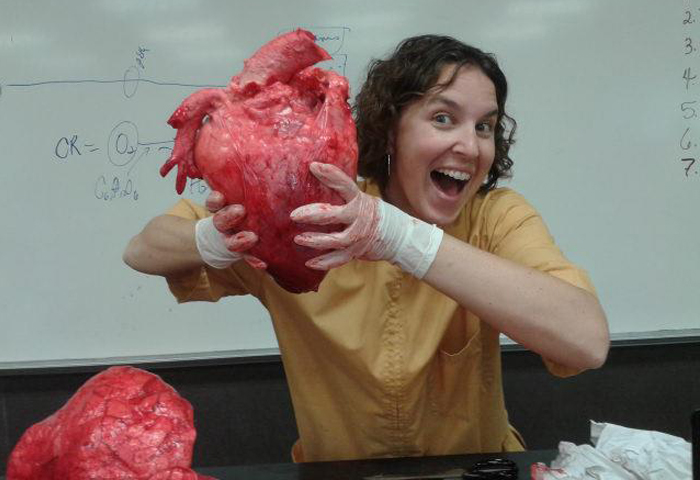 If you spend even a few minutes talking to students about Wendy Riggs, a pattern emerges.
They don’t just remember her classes, they remember how those classes made them feel.
If you spend even a few minutes talking to students about Wendy Riggs, a pattern emerges.
They don’t just remember her classes, they remember how those classes made them feel.
Seen.
Capable.
Like maybe they belonged in a space that once intimidated them.
Wendy, a biology instructor at College of the Redwoods, has built a career not just on teaching science, but on helping students believe they can do hard things. That belief did not come from a textbook. It grew out of her own journey.
She grew up in Klamath Falls, Oregon, active in sports, leadership, and her community. But she also remembers feeling a little out of step, a little different from the environment around her. When she arrived at Humboldt State University, something shifted.
“I thought, oh my god, I’m in heaven,” she said. “I loved the community. I loved the people. I just knew I was where I was supposed to be.”
At first, she imagined herself as an elementary school teacher. Then a biology class changed everything. It was not just the content that drew her in, but the way it was taught. The spark of curiosity. The energy. The sense that learning could feel alive.
That moment clarified something she already felt at her core. She was meant to teach.
She began her career at the high school level, teaching biology and coaching volleyball, building relationships with students day in and day out. Later, after time spent raising her young children and earning her master’s degree, she found her way to College of the Redwoods. She started as associate faculty in 2009 and became full-time in 2014.
What she found at CR was something she still talks about with a kind of gratitude that has not faded.
The students.
“They know where they want to go,” she said. “They’re working really hard to get there. It’s an honor to be part of that.”
Many of her students are on a path toward healthcare, carrying not just academic goals but a deep sense of purpose. They’re balancing work, family, uncertainty, and ambition. They show up anyway.
Wendy meets them there.
In her classes, biology is not abstract. It is personal. It is about their bodies, their futures, their questions. It is about understanding how things work and realizing that they are capable of understanding it.
“We can ask anything,” she said. “How does this work? Why does it work this way? That’s where it gets exciting.”
But the real work often begins when the confidence breaks.
She sees it every semester. The moment a student hits the wall. The moment they decide maybe they are not cut out for this after all.
“They’ll say, I don’t think I can do this,” she said. “And I’m like, actually, you can. You absolutely can.”
What follows is not magic.
It is persistence.
It is guidance.
It is someone standing firmly in your corner while you figure out how to keep going.
Over time, those same students who doubted themselves begin to change. They develop discipline. They learn how to study. They learn how to fail and try again. By the time they reach the end of the sequence, they are not the same students who started.
“They learn how to do hard things,” Wendy said. “And that changes them.”
Even in an online environment, where distance could easily create disconnection, she works intentionally to close the gap. Her lectures are human. She makes fun analogies. She laughs. She lets students see who she is.
And they respond.
They recognize her voice. They reach out. They talk to each other. They build community in spaces that are not supposed to feel personal, and yet somehow do.
“It’s about being present,” she said. “Even when you’re not in the same room.”
That sense of presence extends beyond academics. Years ago, in the middle of teaching, Wendy received devastating news about the loss of a close friend. In that moment, it was her students who stepped forward.
They checked on her.
They supported her.
They showed up with a level of care that she has never forgotten.
“It goes both ways,” she said with a break in her voice. “That’s what makes this place special.”
Wendy continues to invest in the future of her students in practical ways. She is helping build free, non-credit resources to support students preparing for the TEAS exam, removing barriers and creating access where it is often hardest to find.
Because at the center of everything she does is a simple idea. Students can do this. Sometimes they just need someone to show them how. And someone to remind them, again and again, until they believe it themselves.
“I feel really lucky,” Wendy said. “I get to teach something I love, and I get to work with people who are trying to do something meaningful with their lives.”
In a classroom that exists as much in courage as it does in content, something shifts.
And in that shift, it’s Wendy who never stopped believing in them long enough for them to finally believe in themselves.